Publications
Selected publications related to CGM interpretation, glycemic variability, and hypoglycemia physiology.
For a full list of publications, see my Google Scholar and ORCID profiles.
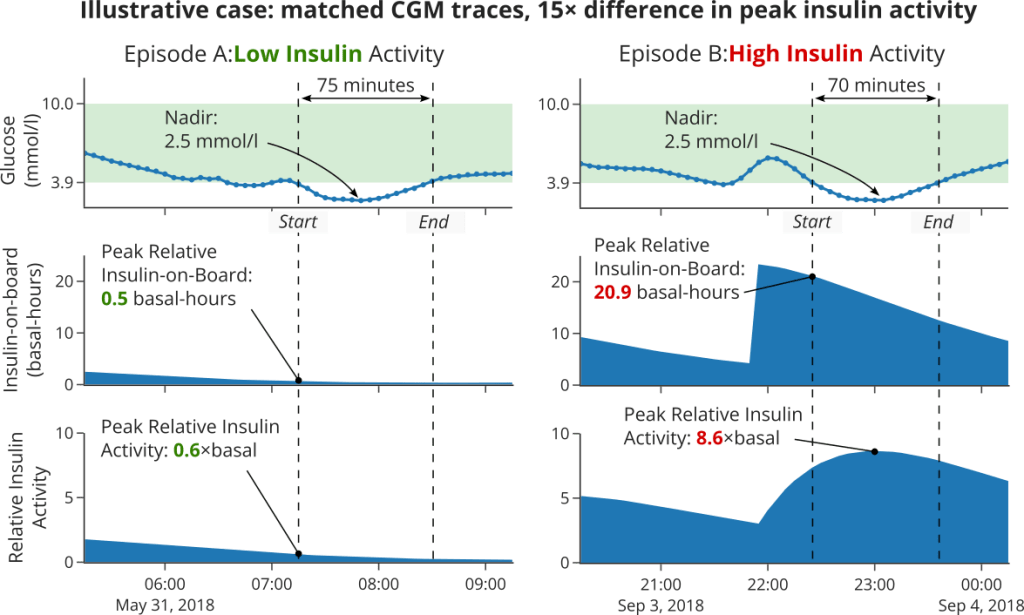
Insulin Activity Varies Widely Across Equivalent Episodes of Hypoglycaemia in Type 1 Diabetes
Richardson RR. Diabetes, Obesity and Metabolism, 2026.
Hypoglycemia is usually assessed using CGM-derived features such as glucose nadir, episode duration, and time below range. This study shows that episodes with similar glucose profiles can occur under profoundly different insulin conditions, even after normalising insulin activity to each person’s usual basal requirements. It identifies “high-insulin hypoglycaemia” as a common but previously uncharacterised state, suggesting that integrated CGM–pump data may reveal clinically important differences invisible to glucose metrics alone.
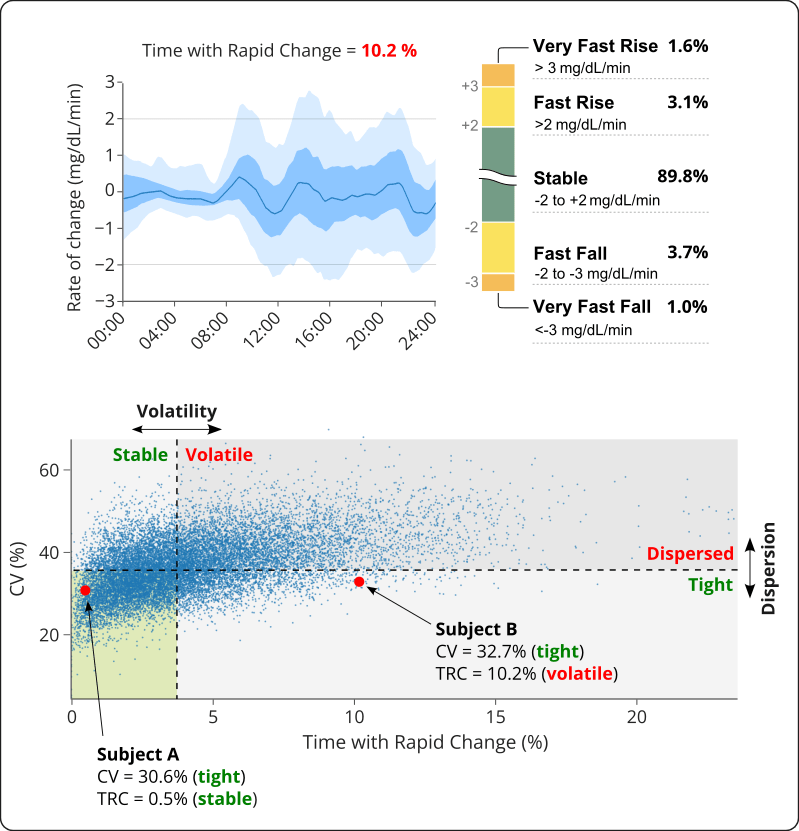
Beyond the Coefficient of Variation: Reframing Glycemic Variability as Dispersion and Volatility
Richardson RR. Diabetes Technology & Therapeutics, 2026.
This article proposes that glycemic variability should be understood along two axes: dispersion (tight vs. dispersed), describing how widely glucose values are spread, and volatility (stable vs. volatile), describing how rapidly and frequently glucose changes over time. Notably, two individuals can have similar coefficient of variation and AGP visuals, yet very different glucose volatility. It also introduces visual summaries such as an ambulatory volatility profile and a dispersion–volatility map.
Goodhart’s Law in Diabetes Care: The Hidden Drawbacks of Overoptimizing CGM Metrics
Richardson R, Thabit H. Diabetes Care, 2025.
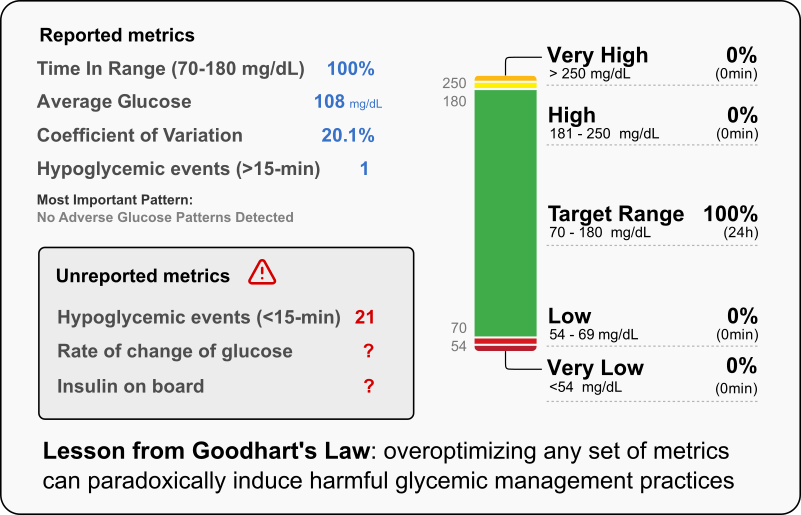
Current CGM metrics are valuable, but they are proxies for the real clinical goal: reducing harm from dysglycemia. This article argues that over-optimising any set of metrics (such as time in range or time below range) can paradoxically induce harmful glycemic patterns, such as mismatched insulin dosing and rapid glucose declines. It presents a “perfect” CGM report with 100% time in range, but with repeated abrupt drops into hypoglycemia, induced by profound excesses of exogenous insulin—patterns invisible to the CGM summary report.
Normal Reference Range for Glucose Rates of Change in Nondiabetic Individuals Using Continuous Glucose Monitoring
Richardson RR. Diabetes Technology & Therapeutics, 2025.
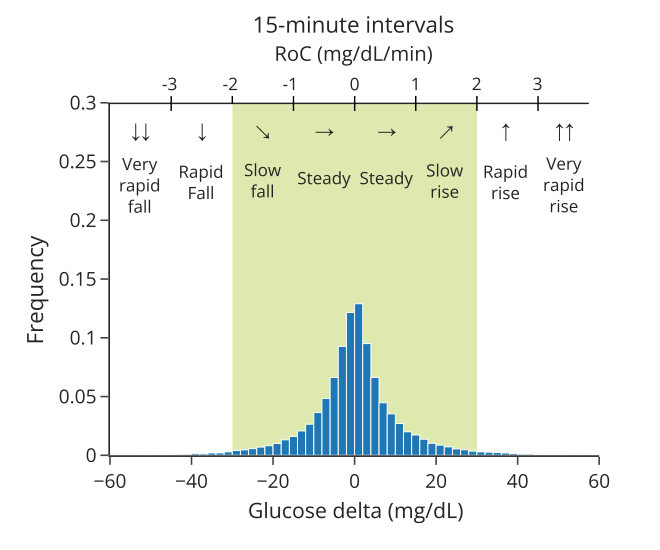
Glucose levels have established reference ranges (e.g. 70–140 mg/dL), but glucose rates of change have historically lacked physiological benchmarks. This study analysed CGM data from 153 people without diabetes to define normal ranges for how quickly glucose typically rises and falls. It showed that changes faster than ±2 mg/dL/min over 15 minutes are rare in normal physiology.
Anaglycemia and Cataglycemia: Proposed Terminology for Glucose Dynamics
Richardson R. Journal of Diabetes Science and Technology, 2025.
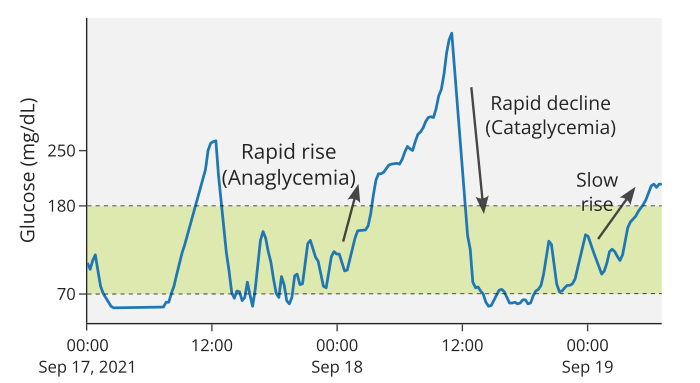
A proposed terminology for rapid glucose rises (anaglycemia), rapid glucose declines (cataglycemia), and relative glucose stability (homeoglycemia). The aim is to support more precise clinical descriptions and research questions, such as in the context of “reactive hypoglycemia,” where symptoms may reflect rapid glucose declines even when glucose does not cross conventional hypoglycemic thresholds.
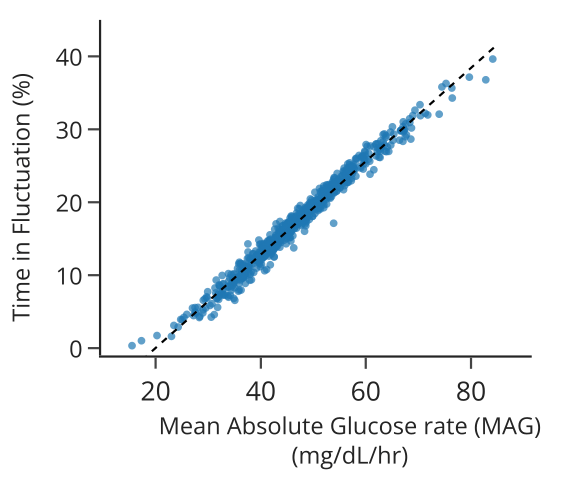
Do Metrics of Temporal Glycemic Variability Reveal Abnormal Glucose Rates of Change in Type 1 Diabetes?
Richardson R. Journal of Diabetes Science and Technology, 2024.
An analysis showing that people with type 1 diabetes spend substantially more time at glucose rates of change outside the range observed in people without diabetes, and that temporal variability metrics—proposed in the literature but not yet adopted in clinical practice—already reflect the time spent with abnormally rapid glucose rate of change.